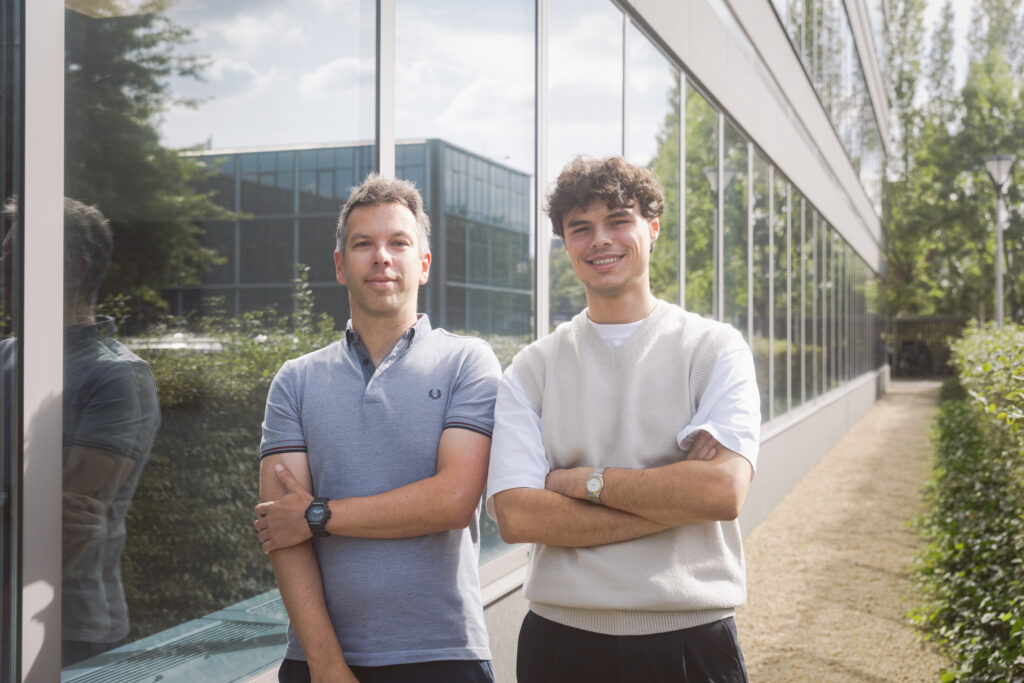
Haiu joins Spire, strengthening our Agentforce expertise
Discover how Haiu combines dedicated Agentforce expertise with Spire’s capabilities in Salesforce, data and integration to make AI work for your business.



Learn how to avoid siloed transformation and scale success through structure with a Center of Excellence.
Structure beats silos
Centralize knowledge to eliminate duplicated effort and scale digital transformation across business units.
Support, don’t control
Build a CoE that gives teams practical tools and frameworks instead of creating administrative friction.
Focus on business value
Prioritize initiatives based on ROI, user adoption, and measurable business impact, not feature volume.
Digital transformation is no longer a question of if, but when and how well. CIOs across industries are constantly being pressured to deliver innovation quickly. But lots of digital initiatives run in isolation. This leads to duplicates, inconsistent standards, and underwhelming impact.
The more complex the organization, the more likely it is for different business units to launch similar digital projects independently. In decentralized structures, each team picks its own tools, vendors, priorities, and governance rules. That sounds good at first, but the lack of a shared foundation leads to some issues:
This costs time and money while undermining project momentum. When results cannot be scaled across the enterprise, promising initiatives will lose credibility. To avoid this lack of credibility and get everyone on the same page, we recommend building a center of excellence.
A center of excellence (CoE) is a centralized team or framework that establishes best practices, shared tools, and clear governance across an enterprise.
Instead of acting as a command-and-control center, a modern digital transformation center of excellence functions as an internal multiplier. It connects business units, coordinates technology investments, and provides the frameworks teams need to deliver digital projects consistently.
Our approach avoids large reports and other bureaucratic bottlenecks. Instead, we co-create a center of excellence structure that enables change that lasts.
A high-performing CoE relies on six dimensions:
By considering all six dimensions and planning accordingly, you’ll be able to build a center of excellence that promotes innovation instead of stifling it.
Align the center of excellence directly with your organization’s mission, growth targets, and digital transformation roadmap. This makes sure the CoE stays grounded in business relevance rather than technology for its own sake.
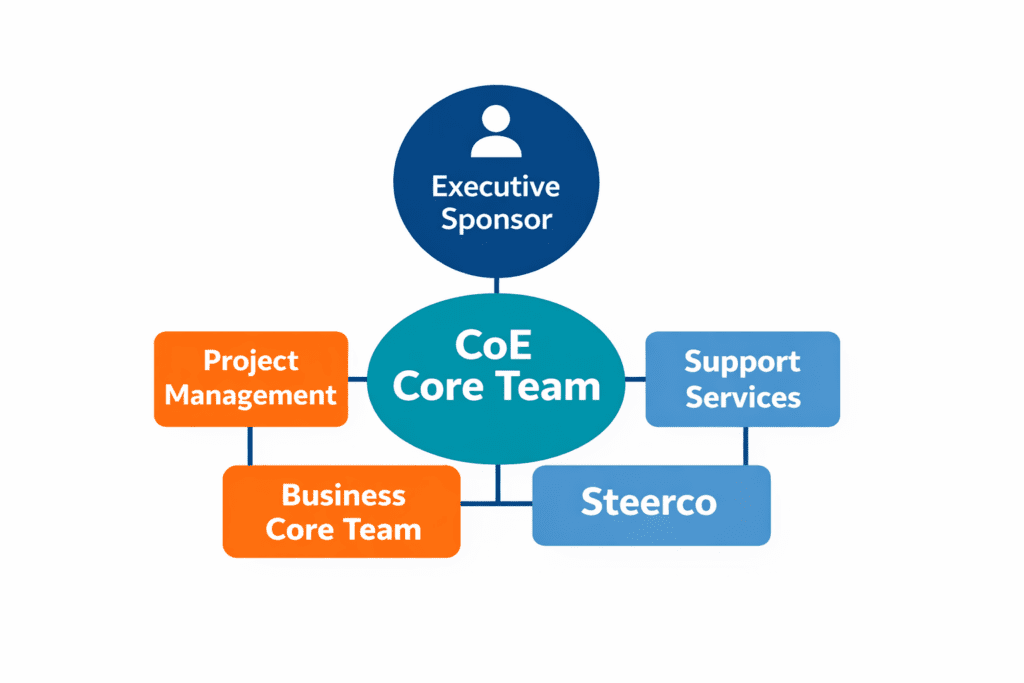
Form hybrid teams that combine business leads, technical architects, executive sponsors, and operational support services. Cross-functional representation creates shared ownership and speeds up decision-making.
Base your project prioritization on concrete outcomes, not on feature volume. As a sort of backlog curator, a CoE focuses on user adoption, ROI, and measurable business value.
Create reusable components, clear role definitions (such as RACI matrices), and shared ways of working. Effective governance isn’t about enforcing strict control, but about building operational consistency.
Use short, iterative cycles to test, adapt, and improve. This Agile mindset applies to solution delivery just as much as how the digital transformation CoE itself operates and evolves over time.
Set clear baselines and readiness assessments to evaluate how new digital initiatives are supported. Clear standards lower security risks and improve coordination across the enterprise.
When set up with clear intention, a center of excellence framework provides the connective tissue for enterprise-wide digital growth. organizations that implement a structured CoE experience clear center of excellence benefits:
Let’s build your Centre Of Excellence together – Let’s talk
Discover how Haiu combines dedicated Agentforce expertise with Spire’s capabilities in Salesforce, data and integration to make AI work for your business.

The five announcements from Dreamforce 2026 worth your attention, translated from keynote language into what actually changes for the people using Salesforce every day.

Dreamforce 2026 preview: the agentic enterprise, Data 360, governance and adoption. What Spire is watching, and why it matters.